This one is a bit nerdy. It covers power systems, signalling, tunnel engineering, and maintenance in detail. If you are looking for a more practical guide to actually using the Tube - how to pay, where to stand, how to get from A to B - start with our complete guide to using the London Underground instead.
The thing that makes the Underground impressive is also the thing that makes it fragile: it has to be old enough to fit inside tunnels bored 160 years ago and modern enough to move around four million journeys a day without falling apart.
You can reduce the Tube to simple components - power, trains, signalling, maintenance - but what makes it remarkable is the integration. A train accelerating out of a station is drawing current, heating the tunnel, pushing air ahead of it, reporting its position to a control system, and trusting that somewhere up the line a set of points, a track circuit, a radio link, and a human being are all doing their own jobs correctly. Most days, they do.
Chapter 1Before it was “the Tube”, it was a smoky trench
The network begins with a simple idea: dig a big slot under the road, put a railway in it, and cover it over again. Early Underground lines were shallow “cut-and-cover” tunnels - easier to build, easier to ventilate, and, crucially, possible before engineers were confident about boring long, tight tubes deep through clay.
By 1863, London had the world’s first underground passenger railway, and it was very much a product of its time. An engineering history published by the Royal Academy of Engineering notes that the first route ran from Paddington to Farringdon, that the trip took 18 minutes, and that it used “gaslit wooden carriages pulled by steam locomotives”. That sentence alone contains enough soot to re-tint your lungs.
The deep-level “tube” lines arrive later, once circular tunnels bored through London Clay become practical. Those smaller tunnels are the Tube’s signature, and also the reason some lines are hotter, tighter, and more acoustically enthusiastic than others.
Chapter 2Tunnels, track, and geometry that punishes complacency
A Tube railway is a set of compromises in cross-section.
Deep-level tubes vs sub-surface tunnels
Deep-level tunnels tend to be circular and relatively narrow. Historically, many were lined with bolted cast-iron segments assembled into rings. Modern tunnelling more often uses precast concrete segments, but a surprising amount of the Underground still relies on older linings, which have their own behaviours over time - including ovalisation, the slow squashing of “circular” into “not quite”. Academic work on cast-iron segmental tunnels describes the lining as “thousands of segmental rings”, with each ring typically made up of multiple segments plus a “key segment at the crown”.
Sub-surface lines, by contrast, often have larger profiles and more generous clearances, because they were built shallower and earlier, then expanded, rebuilt, electrified, resignalled, and generally asked to do far more than their designers imagined. Our guide to Tube depths covers the depth data for every station.
Curves, gradients, and why the Tube squeals
The Tube has tight curves, frequent junctions, and stations close together. That makes for great accessibility and brutal operating conditions: wheel flanges squeal on curves, rails corrugate, and the wheel-rail interface becomes a constant negotiation.
Transport for London openly notes that part of its noise and vibration strategy is straightforwardly mechanical: “continual rail grinding to remove defects on the rail surface”. That is not glamorous, but it is the difference between “some noise” and “a banshee living in the tunnel wall”.
Chapter 3Power: a slightly eccentric four-rail ecosystem
Most people know the Tube is electric. Fewer people know it is electric in a way that is, by global standards, slightly peculiar.
The four-rail system, and why it exists
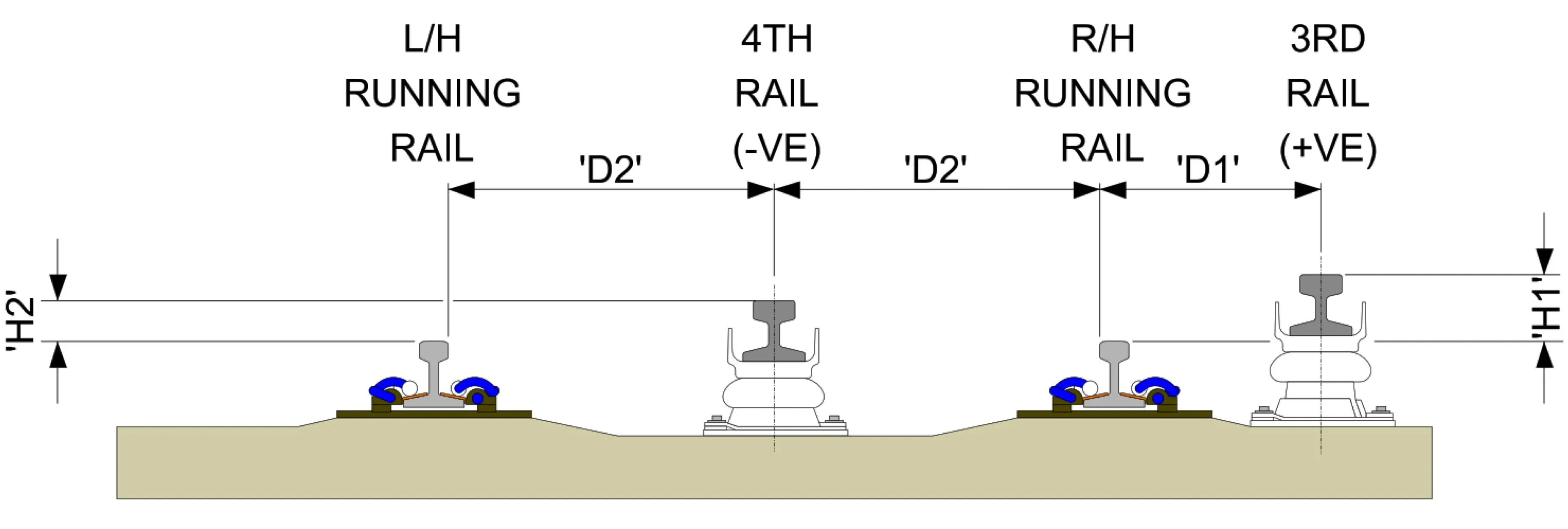
Large parts of the Underground use a four-rail DC system: two running rails (the ones the wheels sit on), plus two conductor rails that supply and return traction current. The point of splitting supply and return away from the running rails is partly operational (it helps keep signalling track circuits reliable) and partly about controlling stray currents that would otherwise wander into tunnel linings and nearby metalwork.
A TfL Freedom of Information response summarises the modern reality bluntly: “the lines are electrified with a four-rail Direct Current (DC) system”.
Voltages: 630 V, 750 V, and “it depends where you are”
The same FOI response (FOI-1862-2122, supplemented by FOI-3676-2324) gets wonderfully specific about the voltages, and it is worth lingering here because this is one of those details that makes the Tube feel like a hand-built instrument rather than a generic metro.
Deep-level tube lines
| Running rails (2) | carry wheels |
| Centre conductor (4th rail) | -210 V |
| Outside conductor (3rd rail) | +420 V |
Nominal 630 V total across the two conductor rails.
Sub-surface lines (mostly)
| Running rails (2) | carry wheels |
| Centre conductor (4th rail) | -250 V |
| Outside conductor (3rd rail) | +500 V |
Nominal 750 V total (some SSR sections still run at 630 V). Regenerative braking can push voltages above nominal - up to around 890 V on the SSR.
Where Underground and third-rail mainline stock share track, the centre conductor rail can be bonded to the running rails, producing a 0 V/+750 V arrangement. That is a polite way of saying: yes, it is standardised, and no, not in the way you hoped.
“Floating” relative to earth
There is another detail that explains why the Underground’s electrical engineers sleep with one eye open. The traction supply is not hard-tied to earth. As TfL puts it in FOI-1862-2122: “The traction current has no direct earth point”, instead using resistors and a defined reference point to manage potentials. This is engineering for a dense city, where you really do not want your railway casually turning nearby infrastructure into an electrochemical experiment.
Substations, rectifiers, and how AC becomes DC
The Underground takes high-voltage AC from the grid, then steps it down and rectifies it into DC for the conductor rails, via transformer-rectifier equipment. London Underground’s own controlled products documentation lists “22kV and 11kV Transformer Rectifiers” among standardised traction supply equipment.
Enthusiast and engineering write-ups fill in the practical picture: traction sections are fed between substations, with arrangements designed to minimise voltage drop when multiple trains draw current at once. (If you have ever felt a train slightly “lazy” leaving a station on a busy section, voltage drop is one of the many suspects.)
Regenerative braking: turning stops into power, sometimes
Modern Tube trains do not just waste their kinetic energy as heat. They can regenerate, feeding electricity back into the traction network when braking - but only if the network is “receptive” (meaning another train is drawing power nearby, or the system can absorb it).
In other words, the Tube is not a giant battery. It is a giant, shared DC busbar with manners. We cover the thermal consequences of all this braking in our piece on why the Tube is so hot.
Chapter 4Rolling stock: from wooden boxes to software-defined trains
The Tube’s trains have evolved from relatively simple vehicles into rolling computers with motors.
Traction equipment: the invisible revolution under the floor
Older stock used DC traction motors with resistor banks and electromechanical control. Modern fleets use solid-state power electronics driving AC motors, with software managing acceleration, wheel-slip protection, and energy use. This matters because the Tube’s constraints are brutal: tight tunnels, short station spacing, heavy passenger loads, and timetables that leave little room for gentle motoring. For an overview of how these constraints affect actual train speeds across the network, see our speed-by-line breakdown.
The new Piccadilly trains: more capacity, more complexity
TfL’s Piccadilly line upgrade page makes a point of energy: the new trains are designed to cut energy consumption by 20% and, for the first time on a deep tube line, bring air conditioning. That last phrase is doing a lot of emotional labour for anyone who has melted between Heathrow Airport and central London in July.
TfL’s 2025 press release describes the new Piccadilly fleet as “the most complex train that has ever been introduced onto the Tube network”. That is not marketing fluff; it is a warning label. Getting new trains to behave on old infrastructure is always part design, part integration testing, and part wrestling match.
Chapter 5Signalling: keeping trains apart, then letting them run closer together
If power is the Tube’s blood supply, signalling is its nervous system. It decides who moves, when, and how fast.
Conventional signalling: blocks, track circuits, and trainstops
Traditional Tube signalling is (conceptually) simple: divide the railway into blocks, allow only one train per block, and enforce obedience.
Divide into blocks
The average Tube block is about 300 metres (TfL, Behind the Scenes: Signalling). Each block entrance has a signal.
Detect occupancy
Track circuits detect whether a train is in the block by passing current through the rails and checking for the short circuit created by a train’s wheels.
Enforce compliance
Each signal has a mechanical “trainstop” next to the track. A train passing a red signal triggers a tripcock on the train, dumping the brake pipe - producing the sort of deceleration that makes you suddenly remember you have knees.
Why signals “fail”, and why that is often the point
Signalling is designed to fail safe. When equipment detects a fault, it prefers to stop trains rather than guess. TfL notes that signal failures can occur when track circuits experience short circuits, including after heavy rainfall.
So, sometimes “signal failure” really means “the system is being cautious in a way that ruins your evening”. You can check whether a signal failure is affecting your line on our live line status page.
CBTC and ATO: letting trains drive themselves (with humans watching)
Modern high-capacity lines increasingly use communications-based train control (CBTC) paired with automatic train operation (ATO). The core benefit is capacity: by continuously knowing where trains are, the system can safely reduce headways, squeezing more trains through the same tunnels. Our piece on when the Tube will be fully automated covers the Grades of Automation and what TfL actually has planned.
A TfL FOI response describes “Thales SelTrac moving-block Communication-Based Train Control (CBTC)”, which can provide “automatic train operation where the train drives itself from one station to the next”. This is used on the Jubilee and Northern lines (and on the DLR).
Enthusiast and operator discussion on RailUK Forums adds a vivid operational detail: when communication fails on an individual train, movements may need to stop, and the train can be driven in “Restricted Manual (9 mph)”. That is the sort of number that makes you realise how much of “fast, frequent Tube” is actually “software plus radio behaving itself today”.
The Victoria line: automation’s grandparent (still doing the job)
The Victoria line has a long relationship with automation. TfL FOI material describes the line’s Siemens Distance-To-Go Radio system, with radio data transmission paired with fixed-block detection. Regardless of the flavour of automation, the pattern is consistent across London: ATO can drive; trained staff still supervise, operate doors, handle degraded modes, and sort out the awkward reality that passengers are not, in fact, predictable.
Chapter 6Control rooms: where the network becomes a living dashboard
Even the best signalling cannot handle everything. You still need humans coordinating disruption, failures, crowding, and the occasional “why is there a swan on the track?” moment (not a joke, just rare).
TfL’s 2013 business plan notes that the “London Underground Control Centre, opened in 2013, has brought operational staff and engineers together under a single command to ensure that incidents are resolved more quickly”. This is the part of the system passengers rarely see: controllers balancing service patterns, regulating headways, issuing instructions, and working out how to recover from a late-running train that has become, effectively, a moving piece of network congestion. A key tool in that recovery is the turnback - reversing trains mid-route to restore service in the core while disruption plays out further along the line. See how interchange times and line availability affect your journey with our interactive travel time map.
Chapter 7Maintenance: the Tube’s second job happens at night
A railway that runs almost all day has to do most of its physical work when trains are not running. That creates a peculiar rhythm: intense, time-boxed night work, plus planned closures, plus constant inspection.
PM1: Day patrols
Inspections carried out during traffic hours. Visual checks of track, signalling equipment, and station infrastructure while the railway is running. (PM1 and PM2 are formal LU maintenance categories.)
PM2: Night patrols
Heavier inspections during engineering hours or possessions. The phrase “engineering hours” sounds gentle. It is not. It is a sprint conducted in confined spaces, with the certainty that the first passenger train is coming whether you are ready or not.
The work itself is relentlessly physical and unromantic: grinding rails, tamping track, replacing points motors, inspecting tunnel assets, cleaning drainage, maintaining fans, and keeping power systems and signalling equipment from quietly ageing into unreliability.
TfL also highlights lubrication as a practical fix for wear: biodegradable rail lubrication reduces friction, rail defects, and noise. There is no romance in grease, but there is a lot of reliability.
Chapter 8Air, heat, and the piston effect
Heat on deep lines is not just “summer weather underground”. It is a long-term thermal problem in clay, plus heat generated by trains, braking, electrical losses, and passengers, accumulating faster than it can be removed. We have a full analysis of Tube heat with TfL’s own platform temperature data.
A building-services analysis in CIBSE Journal reports that a large share of train heat is absorbed by tunnel walls, and that air is moved partly by the “piston effect” as trains push and pull air through tunnels and shafts. TfL itself describes the piston effect clearly: as trains pull into stations, air is drawn in and pushed out via draught relief shafts, a system used throughout the Tube network.
This is why “just add air conditioning” is not a simple fix. Cooling the passenger space often means dumping heat elsewhere, and “elsewhere” is usually the tunnel. Still, the system pushes forward. TfL’s Piccadilly upgrade explicitly frames air conditioning on deep tube stock as a first, pairing it with power upgrades, depot upgrades, and station works to make the whole package viable.
Chapter 9The future: more capacity, more data, and more careful modernisation
The Tube’s future is not one big shiny replacement. It is a rolling programme of upgrades, because the network has to keep running while it changes.
Four Lines Modernisation (4LM)
TfL’s 4LM programme modernises the Circle, District, Hammersmith & City, and Metropolitan lines as a single integrated project, precisely because they share so much track and infrastructure. TfL states the new signalling currently covers 62 stations and major junctions such as Baker Street, Aldgate, and Earl’s Court, with further rollout planned across the full extent of the four lines.
Industry reporting in 2025 describes major signalling deployment milestones on these lines as part of 4LM. The details matter because resignalling a live, complex railway is one of the hardest upgrades you can attempt without closing the whole thing for a year - which London would treat as a direct attack on its identity.
New trains, better energy use, and digitalisation that earns its keep
Predictive maintenance is not sci-fi here. Sensors, condition monitoring, and performance data increasingly inform when assets are serviced, rather than relying purely on time-based intervals. This matters because many failures are not dramatic; they are small degradations that, if caught early, prevent the cascade that ends in a stalled service and a platform full of people practising their thousand-yard stare.
TfL’s own comments about regenerative braking already hint at this systems view: energy reuse depends on network receptivity, other trains, and how the infrastructure is configured. The Tube is increasingly managed as an interacting whole, not a set of independent bits.
Whether you are fascinated by the engineering or just trying to get to work on time, knowing about disruptions before you leave home is half the battle. A delayed journey wastes time regardless of how elegant the signalling system is. You can check the live line status at any time.
We built Tube Notifications to solve this. Choose the lines you use, set the time window that matters, and get an email when something goes wrong - before you head out, not after you are stuck underground. No app, no account, takes 30 seconds, and it is completely free.
Set up a free alert →- Four-rail DC power at nominal 630 V (deep-level) or 750 V (sub-surface, though some sections run at 630 V), stepped down from the grid at substations along the route. Regenerative braking feeds energy back when the network is receptive - and can push voltages above nominal (up to around 890 V on the Sub-Surface Railway, per TfL FOI-3676-2324).
- Fixed-block and CBTC signalling coexist across the network - traditional trainstops enforce safety on older lines while moving-block systems squeeze more capacity from the Jubilee, Northern, and Victoria lines.
- Night maintenance is a relentless sprint - rail grinding, track tamping, points motor replacement, and tunnel inspections crammed into a few hours before the first morning train.
- Heat is a physics problem, not just a comfort one - 160 years of accumulated warmth in clay, with the piston effect doing much of the ventilation work.
- The future is incremental: Four Lines Modernisation, new Piccadilly trains with AC, predictive maintenance from sensor data, and a growing systems view of the whole network.
- Set up a free delay alert - knowing about disruptions before you leave home matters more than understanding the signalling that caused them.
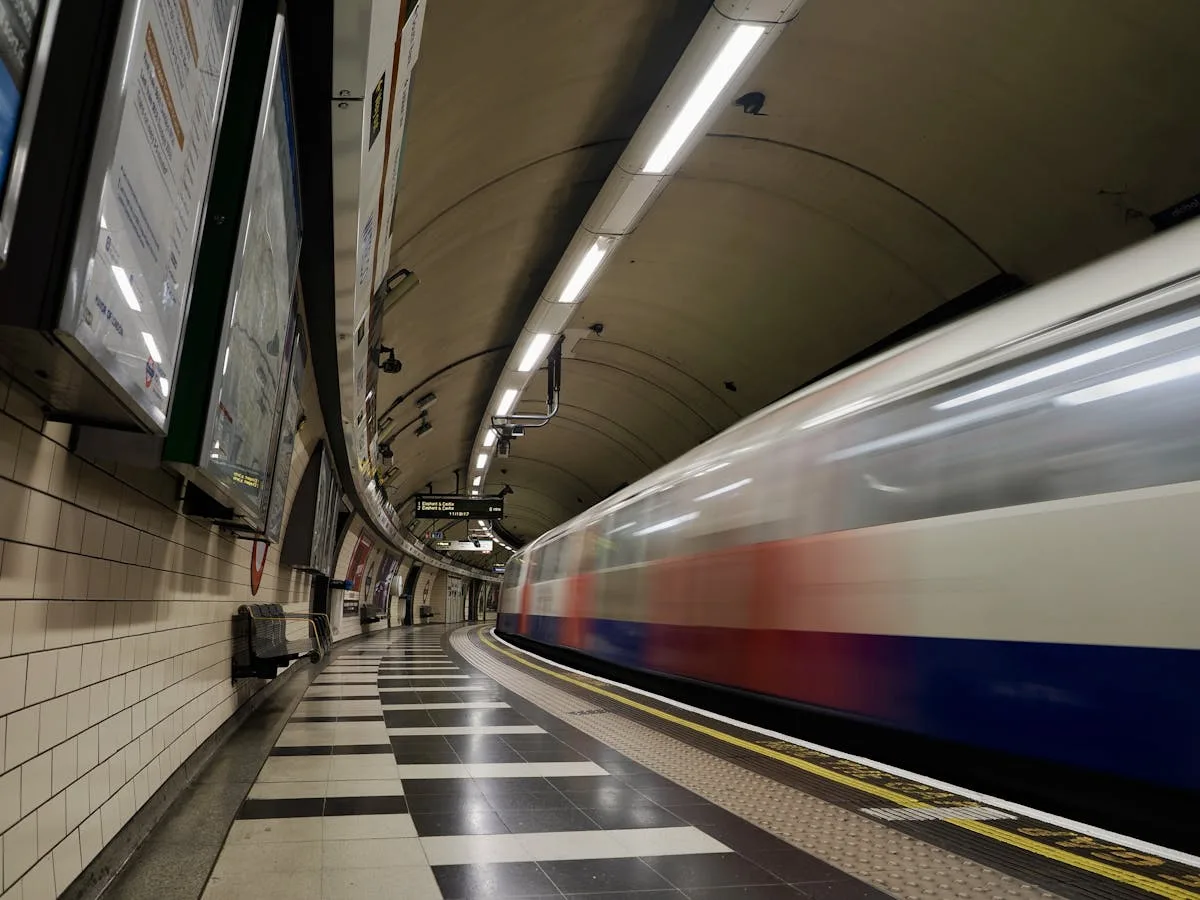
How Fast Does the Tube Actually Go?
Speed data for every line, the braking physics, station spacing models, and global metro comparisons.
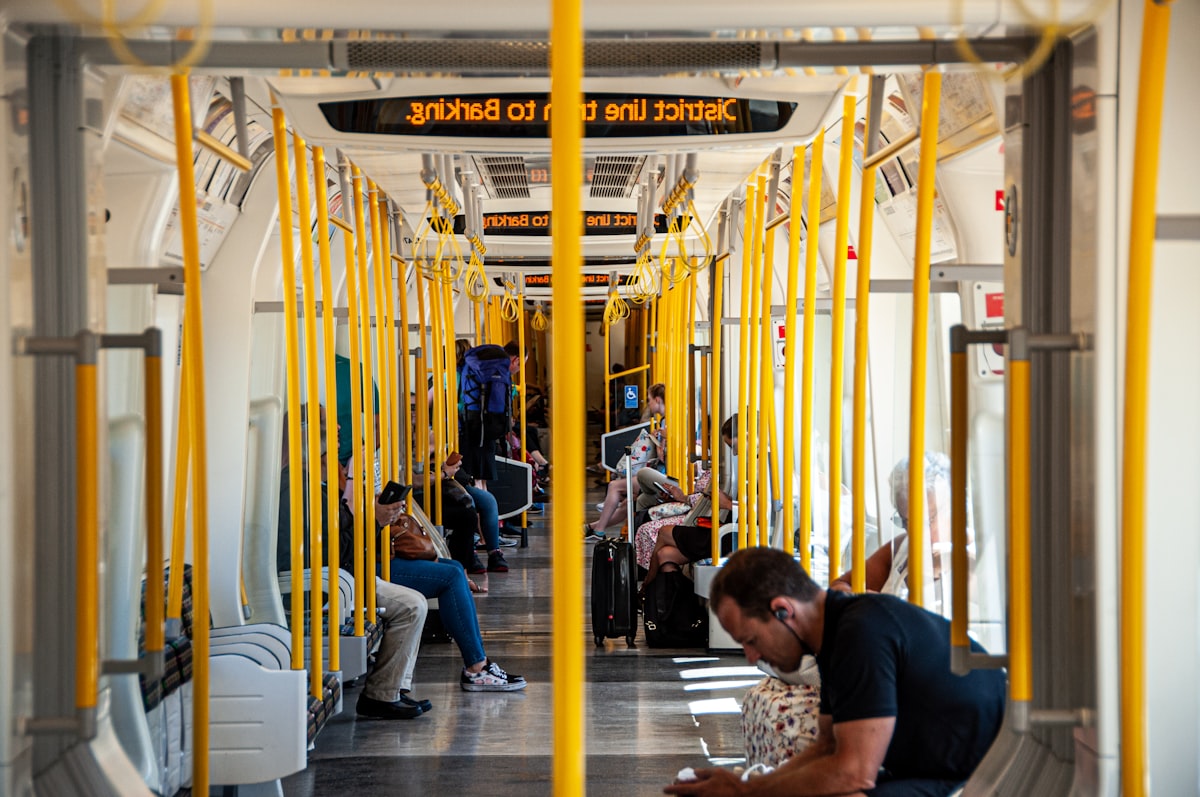
Why Is the Tube So Hot?
Platform temperature data, the physics of tunnel heat, and what TfL is actually doing about it.
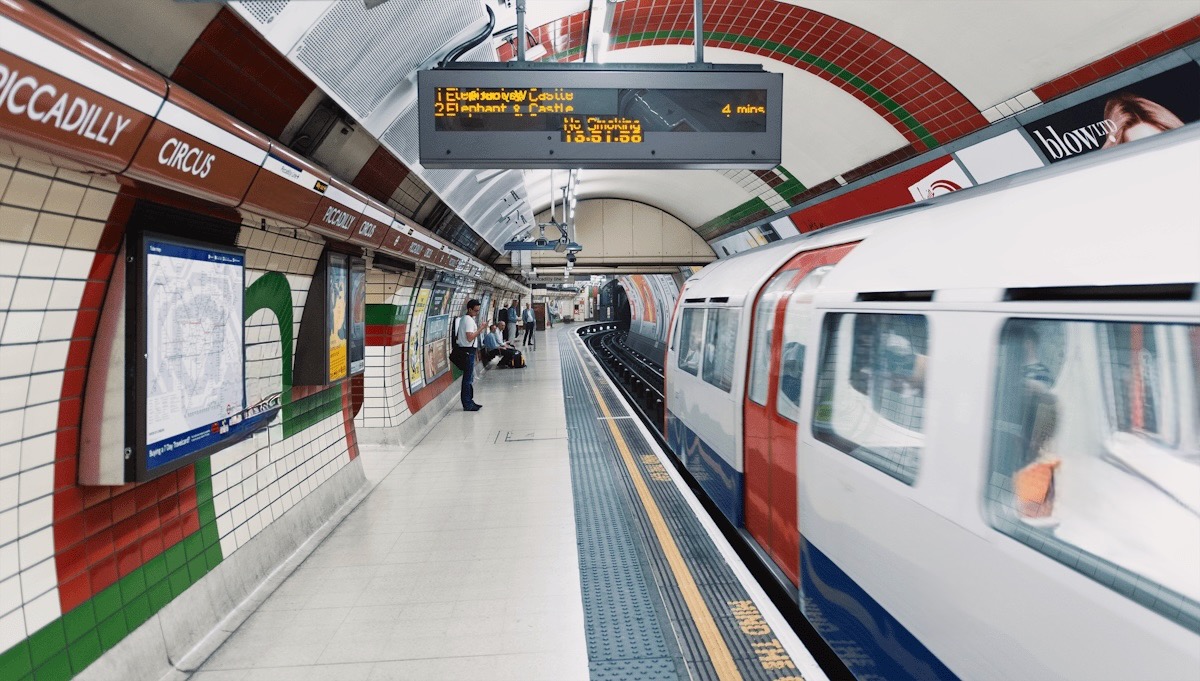
When Will the Tube Be Fully Automated?
CBTC, driverless operation, what is actually planned, and why “just automate it” is never simple.
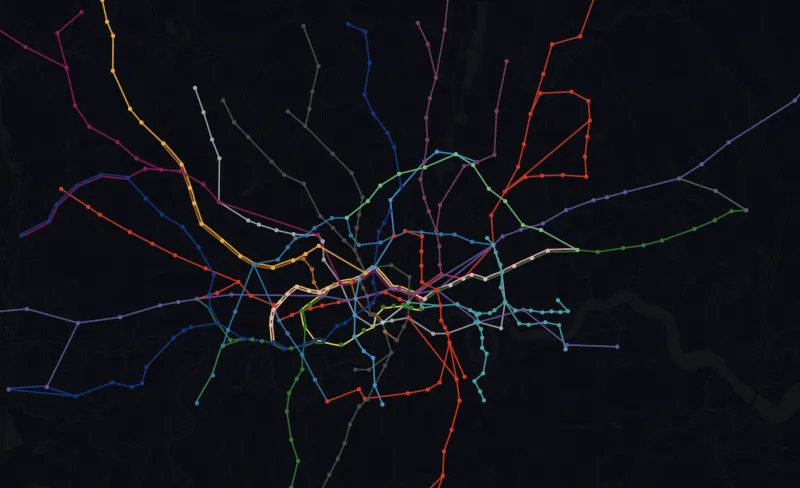
Travel Time Map
Click any station to see journey times everywhere. Toggle lines off to simulate disruptions.