This one is a bit nerdy. It covers pointwork, signalling protection, shunt moves, and timetable mechanics in some detail. If you are looking for a more practical guide to actually using the Tube - how to pay, where to stand, how to get from A to B - start with our complete guide to using the London Underground instead.
The thing that separates a metro from a mainline railway is frequency. And the thing that sets the upper limit on frequency is often not how fast the trains go or how close the signalling lets them run, but how quickly you can turn them around at the ends.
You can reduce the Underground to simple components - power, trains, signalling, maintenance - but the terminus is where all those components collide. A train arriving at the end of the line has to stop, empty, reverse, and leave again before the next one needs the platform. Get that wrong, and the delay propagates backwards through the entire service.
Chapter 1A short history of getting trains pointed the other way
Early Underground railways were built in ways that now feel wildly generous. The original Metropolitan Railway’s cut-and-cover alignments had surface-adjacent construction, space for points, and (comparatively) easier access for maintenance. As the network deepened into small-diameter tube tunnels, every extra junction, crossover, or siding became expensive, spatially awkward, and ventilation-unfriendly. That pushed designers towards doing the simplest thing that works, which is why the network ends up with a patchwork of reversing styles.
The two big historical pressures were:
- Frequency: A terminus is a bottleneck. The faster you can clear the platform and send the next departure, the more trains per hour you can run.
- Geography and money: Sometimes the land exists for a wide throat of points and sidings. Sometimes you are burrowing under priceless buildings and would rather not.
This is how you end up with both the elegant loop at Kennington and the more straightforward, slightly brutal “buffers and a crossover beyond the platform” arrangement that dominates elsewhere.
Chapter 2The Underground’s turnaround toolkit
There are four main ways a Tube train reverses. In real life, they often combine.
Crossover
Two platform tracks with pointwork beyond the station. The train swaps tracks and heads back. The commonest pattern.
Turnback Siding
A short track beyond (or between) platforms where the train clears the platform, reverses, and returns without blocking the throat.
Reversing Loop
A one-way circular track. The train empties, continues around the curve, and reappears heading back - no cab change needed.
Mid-Route Turnback
Not at the end of the line. Trains reverse mid-route to match supply to demand or recover from disruption.
1. Crossovers at or beyond the terminus
The commonest pattern is: two platform tracks, one for arrivals and one for departures (or at least two parallel running lines), with a crossover beyond the station so an arriving train can swap to the other track and head out.
A crossover is simply a pair of pointwork connections that lets a train move from one track to the other. Depending on where it sits relative to the direction of travel, it can be a facing move (points encountered “nose first”) or a trailing move (points approached from the “open” end). Trailing moves are generally operationally friendlier because the train is already moving in the direction the points “want” to be taken, and there are fewer awkward conflicts with an incoming train.
The catch is that crossovers are a capacity constraint. Every train has to pass through the same few metres of junction at low speed, with signalling protection wrapped around it. In a high-frequency environment, those seconds matter.
2. Turnback sidings and reversing roads
If you want a terminus that behaves less like a dead end and more like a machine, you add a siding.
A turnback siding is a short length of track, usually beyond (or occasionally between) platforms, where a train can clear the platform, reverse, and return without blocking the main throat. Sometimes it also doubles as a place to “regulate” service, hold a late-running train, or stash one temporarily during disruption.
A classic layout is a central reversing siding between the running lines. Wembley Park on the Jubilee line is a well-known example of reversing via a siding to the west of the station, used to turn trains and manage depot access.
The big operational advantage is that platforms can be reoccupied sooner. In timetable-planning language, what matters is not just dwell time but the time until the platform can accept the next train. (Rail planners have a special talent for inventing terms that sound like they came from a dishwasher manual.)
3. Loops
Loops are the most fun, because they look like the railway is briefly pretending to be a Scalextric set.
A reversing loop is a one-way circular track that lets a train come in, empty, continue around a curve, and reappear ready to head back without the train operator needing to change ends before the movement.
The famous one is the Kennington Loop, used to turn some Northern line trains in a compact underground circle. TfL-adjacent writing has described the manoeuvre as “a giant subterranean circle”, which is both accurate and an excellent description of half of Zone 1’s street network.
Loops are not common because they take space, introduce sharp curvature constraints, and can be operationally awkward if you want to reverse trains in both directions. But where they exist, they can be remarkably efficient.
There is a surface-level cousin of this idea at Heathrow: the Piccadilly line serves Heathrow Terminal 4 via a loop, allowing one-way circulation through the airport stations.
4. Mid-route turnbacks (short workings)
Not every reversal is at the end of the line. Mid-route turnbacks exist for two reasons:
- Service control: matching supply to demand, especially on branched lines.
- Disruption recovery: if something breaks further out, you still want a good service in the core.
On the Central line, for instance, TfL has discussed reversing some trains at Leytonstone (or Woodford) to concentrate capacity where most passengers actually are.
If you have ever been on a train that suddenly announces it is terminating somewhere you had not mentally filed under “places a train can terminate”, congratulations. You have witnessed a short working in the wild.
Chapter 3The choreography: what actually happens during a reversal
From the passenger’s perspective, a terminus reversal looks like “we arrived, we left”. Under the hood, it is a tight sequence of constraints.
Arrive, stop, detrain
The train arrives under signalling authority, stops precisely in the platform, opens doors, and empties. At a busy terminus, staff dispatch is as important as pointwork. Slow detraining can do as much damage as a failed set of points.
Change ends (unless you are looping)
In the standard two-cab train, the operator secures the train and walks to the other cab. That walk time is pure overhead. It does not move passengers. It only consumes capacity.
Set the route and protect it
A reversal is a low-speed, high-risk move. You are often moving through points at restricted speed, crossing from one running line to another, and potentially performing a shunt move. Signalling protection is deliberately conservative.
Deal with shunt signals and trainstops
Low-speed movements into sidings or across crossovers are governed by shunt signals. Behind those signals sits the trainstop and tripcock system - a physical fail-safe that will stop a train if it tries to take a movement it should not.
Stepping back: the relay race
To reduce the overhead of the cab walk, the Underground uses a technique called stepping back. In the Northern line working timetable, it is described explicitly: during defined peak periods “Train Operators will Step Back five trains.”
How stepping back works
The arriving operator steps off, and a fresh operator steps into the cab for the departure. The arriving operator then becomes the departing operator of the next train in the opposite direction, and so on. It cuts the “walk the full length” time out of the critical path, which is exactly what you want at a bottleneck terminus.
Shunt signals and the trainstop
London Underground has its own distinctive shunt signal style. Signalling reference material describes them as white discs with a red band that rotates to indicate “proceed”.
Behind this quaint-looking disc is an unapologetically physical safety layer.
The London Transport Museum explains the concept in plain terms: when raised, the trainstop arm is positioned to hit a valve called a tripcock on a passing train, causing it to stop. A tripcock sits near the front of the train, and if it hits a raised trainstop it triggers a brake application that must be reset after stopping.
If you are wondering whether this all makes reversals slower: yes, it can. If you are wondering whether it makes them safer: also yes, emphatically.
Chapter 4The maths of a terminus, and why it dictates frequency
A Tube line’s maximum frequency is often set not by how fast trains can run between stations but by how quickly you can cycle them at the ends.
Modern planning documents obsess over this. Timetable-planning rules define things like “technical headway” and “platform reoccupation”, which are essentially formal ways of describing “how close can we safely run trains without the second one being checked”.
On the Underground, this is why layouts that clear the platform quickly - turnback sidings, stepping back, automatic route setting - punch above their weight.
Chapter 5Software joins the party: ATO, CBTC, and tighter turnarounds
The Underground has been moving, line by line, from traditional fixed-block signalling to communications-based control, where trains can run closer together, with automation assisting speed control and station stopping.
TfL’s Four Lines Modernisation programme (Circle, District, Hammersmith & City, and Metropolitan) is explicit about the aim: newer signalling “allows trains to be run closer together”, improving frequency and reliability, with a stated ambition of 32 trains per hour in the central section.
On deep tubes, the headline example is the Victoria line, which operates 36 trains per hour at the busiest times - a train every 100 seconds.
Those frequencies make turnaround discipline non-negotiable. If your terminal process drifts, you do not just lose a minute, you lose the entire rhythm of the line.
Automation helps because: precise stopping reduces dwell variability, automatic route setting can reduce human reaction time, and moving-block control can allow closer approaches to platforms and junctions.
On the Northern line, TfL board material notes that the line was upgraded with Thales TBTC signalling, enabling peak service increases - for example, to 24 trains per hour on both central branches, and up to 30 trains per hour on the Kennington to Morden section in the busiest period.
That is the point where “turning trains around” stops being just a station-end ritual and becomes a system-level performance feature.
Chapter 6Three very different reversals
The Kennington Loop
The Kennington Loop is a tidy piece of underground geometry that lets certain Northern line trains terminate and return northbound without the train operator changing ends before the movement.
Operationally, its superpower is that it takes pressure off the platform and the junction, and it can be used flexibly to regulate service between branches. TfL commentary around the Northern line extension noted the intention to reduce loop use as some trains continue beyond, rather than terminating.
The working timetable’s 0.98 km figure is a reminder that this is not a tiny wiggle. It is a proper loop, with real running time and signalling protection. The same timetable also describes “double-staffing” some trains via the loop to support the service pattern.
Heathrow Terminal 4
The Piccadilly line’s Heathrow arrangement reflects the staggered development of the airport itself. The branch was extended to serve Heathrow in the 1970s, and later extended again to Terminal 4 via a loop opening in the mid-1980s, with Terminal 5 added later via a different alignment.
A loop makes sense here because it allows one-way circulation through the airport stations. From an operational standpoint, it reduces the need for complex pointwork under the airport, and from a passenger standpoint it provides a simple “this train will go around and come back” pattern.
(Also, if you have ever tried to drive around Heathrow, you will respect any transport designer who looks at it and thinks, “yes, a loop is the least confusing option.”)
Wembley Park
Wembley Park demonstrates a different philosophy: do not wait until the end of the line to regain control of the service. Put reversible capacity where it helps you manage uneven demand, depot access, and disruption.
Reversals are done via a reversing siding to the west of the station, usable in both directions. This kind of intermediate reversing point is what allows a line to “trim” its service pattern - running a heavy core service without committing every train to the full length of the route.
That is exactly the kind of flexibility you want when you have a stadium that occasionally disgorges tens of thousands of people into your Jubilee line platform.
The control room reality: reversals as disruption management
On a perfect day, reversals are tidy, clockwork operations. On a real day, they are the network’s pressure valves.
When there is a blockage, a late-running train, or a failure that strands stock on the wrong side of the line, controllers reach for turnbacks to protect the core. This is why mid-route turnbacks are so valuable, and why their loss can be felt for years.
A turnback is not just a place to reverse. It is a way to: restore even intervals after a delay, keep service running where demand is highest, and stop disruption propagating to the far ends, where it becomes harder to recover.
The irony is that passengers often interpret a short working as the network giving up. In reality, it is usually the network trying to avoid giving up.
Chapter 8So, how does the Tube turn around?
It does it with a mixture of geometry, rules, people, and software.
- Geometry - crossovers, sidings, and loops, shaped by Victorian constraints and modern demand.
- Rules and protection - signals, interlockings, trainstops, and speed discipline enforced at every shunt move.
- People - dispatch, stepping back, and control-room regulation keeping the rhythm tight.
- Software - ATO and CBTC tightening the margins and reducing variability.
- The visible bit - the driver walking through the train - is often the least interesting part. The real story is the system underneath, designed so a train can arrive, empty, reverse, and depart with minimal wasted time and minimal risk.
- Set up a free delay alert - knowing about disruptions before you leave home matters more than knowing how the train reversed.
Whether you are fascinated by the engineering or just trying to get to work on time, knowing about disruptions before you leave home is half the battle. A delayed journey wastes time regardless of how efficiently the train reversed. You can check the live line status at any time.
We built Tube Notifications to solve this. Choose the lines you use, set the time window that matters, and get an email when something goes wrong - before you head out, not after you are stuck underground. No app, no account, takes 30 seconds, and it is completely free.
Set up a free alert →Power, Signalling, Maintenance and Engineering
The four-rail power system, CBTC and fixed-block signalling, tunnel construction, rolling stock, and night maintenance.
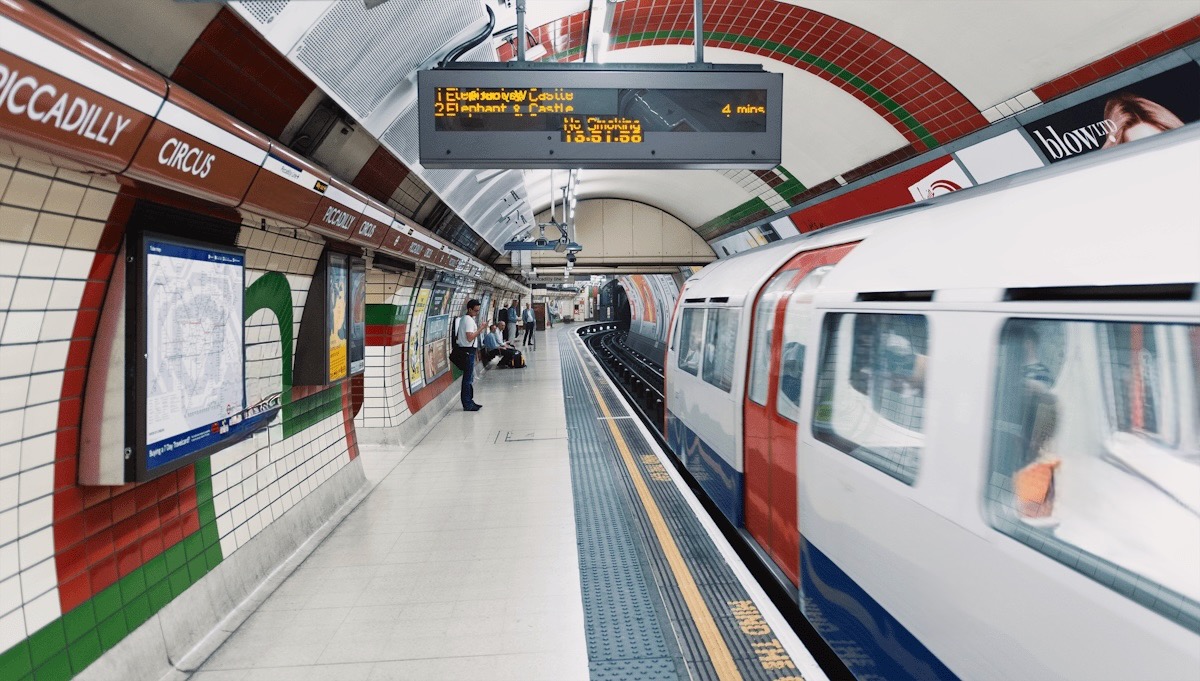
When Will the Tube Be Fully Automated?
CBTC, driverless operation, what is actually planned, and why “just automate it” is never simple.
How Fast Does the Tube Actually Go?
Speed data for every line, the braking physics, station spacing models, and global metro comparisons.