London’s fare system is not complicated once you know the handful of rules that actually matter. Most of the “I got overcharged” stories come down to three things: not tapping correctly, not knowing about pink readers, or mixing payment methods. This guide covers every fare that matters in 2026, the March price changes, and the specific mistakes to avoid.
If you are new to the Tube entirely, start with our complete guide to using the London Underground - it covers payments, etiquette, navigation, and everything else a newcomer needs.
What changes from 1 March 2026
Two fare changes take effect in March. Understanding them saves you from reading outdated advice.
- Adult PAYG single fares on Tube, DLR, Overground, and Elizabeth line (Zones 1-6) rise by about 6%. This is the per-journey price when you tap in and out with contactless or Oyster.
- Daily and weekly caps stay frozen. The maximum you can spend in a day or a week does not change. Caps are frozen until at least 2027.
The result: each individual journey costs slightly more, but if you travel enough to hit the cap, you pay the same as before.
Buses and trams are different. The adult bus/tram single (£1.75), the daily cap (£5.25), and the 7 Day Bus & Tram Pass (£24.70) are all frozen in March. That freeze runs until 5 July 2026.
The only three things that usually change your fare
Before looking at the numbers, understand what determines whether you pay more or less. Everything else is detail.
Touching in and out correctly
Rail (Tube, DLR, Overground, Elizabeth line, and most National Rail in London): touch in at the start and touch out at the end on the yellow readers.
Bus and tram: touch in only. There is no touch out. If you tap by mistake near the exit, you could trigger an extra charge.
If you miss a touch, you may be charged a maximum fare, and it can prevent capping from working properly.
Touching the pink reader when it matters
Pink readers exist at certain interchange stations to prove you did not go through Zone 1. If you skip them, the system may assume you went through Zone 1 and charge more.
How to use them (when your route avoids Zone 1): touch in (yellow) → touch pink when changing trains → touch out (yellow).
TfL lists the main stations with pink readers: Stratford, Canada Water, Highbury & Islington, Whitechapel, Clapham Junction, Richmond, Wimbledon, and others.
Using the same card or device the whole journey (and ideally the whole day/week)
Capping only works if the system can link your trips. Always touch in and out with the same thing - same physical card, or the same phone/watch.
Avoid “card clash” (multiple cards in the same wallet or phone case) because it can split a single journey across two payment methods and trigger maximum fares.
Peak and off-peak: the rule people get wrong
Peak/off-peak is based on the time you touch in, not when you board, not when you change, and not when you touch out.
Peak: Monday to Friday (excluding public holidays), 06:30-09:30 and 16:00-19:00.
Off-peak: all other times. And one important quirk - journeys from outside Zone 1 into Zone 1 during the evening peak (16:00-19:00) are charged off-peak.
Night Tube / Night Overground fares: always off-peak.
Heathrow special rule: Tube and Elizabeth line journeys to/from Heathrow Airport are charged peak if they start, end, or go through Zone 1 during peak hours.
The fares that matter most (with the March 2026 change)
A) Adult PAYG single fares on Tube and TfL rail (Zones 1-6)
These are the per-journey fares most people care about. “Including Zone 1” means your classic journey into central London. “Excluding Zone 1” is where pink readers can save you money. To see how these fares have changed over the past 21 years, see our interactive fare tracker.
| Zones | Inc. Zone 1? | Peak (to 29 Feb) | Off-peak (to 29 Feb) | Peak (from 1 Mar) | Off-peak (from 1 Mar) |
|---|---|---|---|---|---|
| 1 | Yes | £2.90 | £2.80 | £3.10 | £3.00 |
| 2 | Yes | £3.50 | £2.90 | £3.60 | £3.10 |
| 3 | Yes | £3.80 | £3.10 | £3.90 | £3.30 |
| 4 | Yes | £4.60 | £3.40 | £4.80 | £3.60 |
| 5 | Yes | £5.20 | £3.60 | £5.30 | £3.80 |
| 6 | Yes | £5.80 | £3.80 | £5.90 | £4.00 |
| 2 | No | £2.10 | £2.00 | £2.30 | £2.20 |
| 3 | No | £2.30 | £2.10 | £2.50 | £2.30 |
| 4 | No | £3.00 | £2.20 | £3.20 | £2.40 |
| 5 | No | £3.20 | £2.30 | £3.40 | £2.50 |
| 6 | No | £3.60 | £2.40 | £3.80 | £2.60 |
The “excluding Zone 1” prices only apply if you take a route that avoids Zone 1 and touch a pink reader at the interchange to prove it. Otherwise the system assumes the more expensive route.
B) Daily and weekly caps - the maximum you will pay
Caps are the simplest optimisation for most adults: keep tapping, and the system stops charging once you hit the cap. All caps for Zones 1-6 are frozen in March 2026. Daily caps have had a dramatic history - they were slashed 24% overnight in 2015 when TfL restructured how they are calculated.
- Daily cap window: 04:30 to 04:29 the next day.
- Weekly cap window: Monday to Sunday (not a rolling seven days - which matters if you arrive midweek).
| Capped zone range | Daily cap (anytime) | Weekly cap (Mon-Sun) |
|---|---|---|
| Zone 1 only | £8.90 | £44.70 |
| Zones 1-2 | £8.90 | £44.70 |
| Zones 1-3 | £10.50 | £52.50 |
| Zones 1-4 | £12.80 | £64.20 |
| Zones 1-5 | £15.30 | £76.40 |
| Zones 1-6 | £16.30 | £81.60 |
C) Bus and tram fares (and why they are usually the cheapest option)
| Product | Price |
|---|---|
| PAYG single | £1.75 |
| Daily cap | £5.25 |
| Weekly cap (Mon-Sun) | £24.70 |
| 1 Day Bus & Tram Pass | £6.00 |
Buses and trams also have the Hopper fare: unlimited transfers within one hour when you keep using the same payment method and keep touching in. This makes short, multi-bus hops very good value. Bus fares have risen from just 80p in 2005 - see the full bus fare history.
Cards and tickets: what to use (and why)
Contactless
Card, phone, or watch. Tap in and out. Automatic daily and weekly caps. No top-up.
- Must be the same device/card for tap in and out
- Ideally use the same one all day/week for capping
- Cannot apply Railcard discounts
Oyster
Use if you need a concession (Zip, student, apprentice, 60+), or if you have a Railcard whose discount you want on PAYG fares.
- Most Railcards can be added to Oyster
- Contactless does not support Railcard discount
- Requires manual top-up
Travelcards
On Oyster or paper. Use if you travel a fixed set of zones often enough that a 7 Day (or longer) card is cheaper than PAYG, or your week runs Thursday to Wednesday.
- Weekly cap on contactless runs Mon-Sun only
- Travelcard lets you pick your own 7-day window
- Check TfL calculator for your specific zones
The answer depends on your zones, how many days a week you travel, and whether your week resets on a Monday. Our commute cost calculator compares PAYG, weekly Travelcard, and annual season ticket for your exact pattern - using the March 2026 fares above.
Try the calculator →Discounts that actually move the needle
There are many concession types, but these are the ones that change day-to-day fares, caps, or both.
| Discount / card | What it does | Practical gotcha |
|---|---|---|
| 16+ Zip Oyster | 50% off adult PAYG on bus and rail in London (with some exclusions), and free bus/tram travel if you live in London | Needs the photocard - not automatic on contactless |
| 18+ Student Oyster | 30% off adult-rate Travelcards and Bus & Tram Pass season tickets | The 30% is for season products, not PAYG |
| Bus & Tram Discount | 50% off adult PAYG bus/tram fares and some Bus & Tram Passes | Bus/tram only - does not apply to Tube or rail |
| National Railcard on Oyster | Usually 1/3 off off-peak PAYG fares and off-peak caps (Disabled Persons Railcard differs) | You must add the Railcard to an Oyster to get the discount |
| Under-11s (with adult) | Up to four under-11s travel free with a fare-paying adult on Tube/rail (and free on buses/trams) | May need to speak to staff at gates |
Many discounts require an Oyster photocard. They are not something you can “switch on” for contactless at the gate. If a discount applies to you, check whether you need a specific card to access it.
The tapping edge cases that cause real overcharging
Out-of-station interchanges (OSIs)
An OSI is when TfL expects you to leave one station and enter another nearby as part of one journey. This is normal at complex interchanges (Bank/Monument, Paddington Underground to Elizabeth line). If you take too long between the tap-out and tap-in, it becomes two separate journeys and you lose capping continuity. TfL publishes an OSI list with maximum interchange times.
Maximum fares, and getting them back
If you did not touch in or out properly, TfL advises:
- Wait at least 48 hours - you might get an automatic refund.
- You cannot claim if you have already had 3 maximum fare refunds in the same calendar month.
Card clash
If the reader sees two contactless cards at once, it can read the “wrong” one, or read one on entry and a different one on exit - producing two incomplete journeys and two maximum fare charges. Keep your travel card or phone separate from other contactless cards.
How to maximise value (without getting cute)
Default to PAYG with capping. In most normal weeks, PAYG with caps does not exceed a 7 Day Travelcard price, and you only pay on the days you actually travel.
Avoid Zone 1 when it is genuinely avoidable, and touch pink readers at the interchanges TfL lists. This is the single most common “I could have paid less” mistake on rail.
Travel off-peak when you can. Remember it is the touch-in time that matters. Just after 09:30 is a different fare bracket.
If you have a Railcard, consider Oyster so you can actually use the discount. Contactless will not apply it.
Use buses for short hops, especially if you might chain two or three trips inside an hour (Hopper fare).
Do not split payment methods across a day or week if you are expecting caps to protect you.
Brief alternatives (when Tube optimisation is not the answer)
- Bus: often cheapest for 1-3 stops, and the Hopper fare makes multiple hops within an hour good value.
- Walking: in Zones 1-2, many “Tube” trips are 10-25 minutes on foot once you include waiting and corridors.
- Cycling: Santander Cycles (and other hire schemes) can beat central travel times at peak.
- Tram: useful in south London where rail options are sparse (still within the bus/tram fare system).
If you are new to London and want a broader overview - how to navigate the network, etiquette, Night Tube, airports, and more - see our complete guide to using the London Underground.
Whether you are optimising fares or just trying to get to work, knowing about disruptions before you leave home is the other half of the equation. A delayed journey is an expensive journey - both in time and in missed connections that break your capping. You can check the live line status any time.
We built Tube Notifications to solve this. Choose the lines you use, set the time window that matters, and get an email when something goes wrong - before you head out, not after you are stuck underground. No app, no account, takes 30 seconds, and it is completely free.
Set up a free alert →- From 1 March 2026, PAYG singles rise ~6%. Daily and weekly caps are frozen until at least 2027.
- Bus/tram fares frozen until 5 July 2026. Single £1.75, daily cap £5.25, Hopper fare for unlimited transfers within an hour.
- Peak is 06:30-09:30 and 16:00-19:00 weekdays. Based on touch-in time. Night Tube is always off-peak.
- Use contactless for simplicity. Use Oyster if you need concessions or Railcard discounts on PAYG.
- Touch pink readers when avoiding Zone 1. This is the most common missed saving on the network.
- Same card, same device, all day. Do not mix payment methods or you lose capping.
- Set up a free delay alert - a disrupted journey wastes time and can break your fare cap.
- TfL Fares - official fare tables and calculator
- TfL Caps and Travelcard Prices - daily and weekly caps
- TfL Pay As You Go - contactless and Oyster PAYG information
- TfL Free and Discounted Travel - concessions and Railcard discounts
We build highly customisable tube alerts for the London Underground, Overground, DLR, and Elizabeth line. Whether you are a daily commuter or a tourist visiting for a week, choose the lines you will be using, set a time window, and we will only email you when something actually goes wrong. Free, no app required, and takes 30 seconds.
Set up a free alert →
How to Use the London Underground
The complete 2026 guide - payments, etiquette, navigation, Night Tube, airports, and everything else.
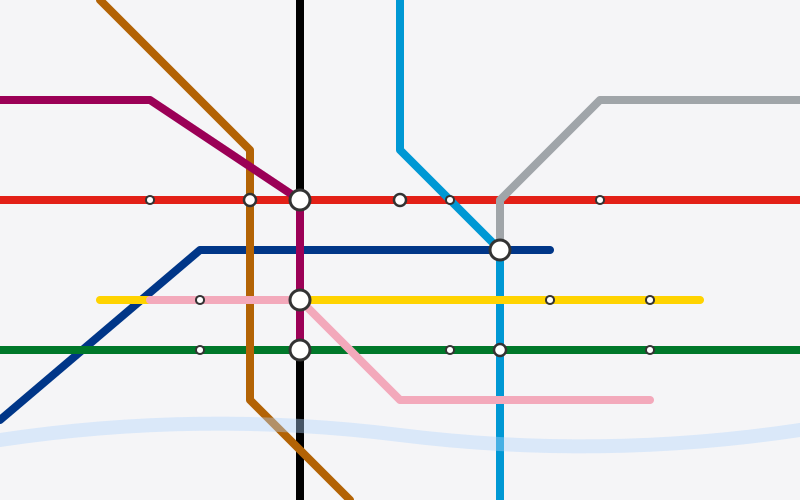
London Tube Map: How to Read It
The design tricks, distance distortions, and practical tips for navigating the map.
TfL Fare Tracker: 21 Years of Prices
Interactive charts showing how Tube and bus fares have changed from 2005 to 2026, with inflation adjustment.
Fares are reviewed by TfL periodically. We update this guide when prices change. Send us a tip if you spot something we should correct.