Transport for London has refused to release the documentation behind its £190m fare evasion estimate, and part of its written justification concerns Instagram.
The estimate rests on more uncertainty than its presentation implies. As Tube Alerter revealed last week, the £190m carries a 10 per cent downward adjustment to reflect the limits of TfL's own data, TfL rates the assumptions behind the calculation "medium confidence", and the bus survey supplying it excludes passengers who decline to take part. We had asked for the methodology used to calculate the published rates. TfL provided a description of its approach but refused the underlying documentation in full, citing exemptions for law enforcement. If anything, this uncertainty is a strong argument for disclosure.
Its internal review, explaining that refusal, states: "We're increasingly seeing operational information being shared publicly via the [names withheld] Instagram accounts and other public websites."
According to TfL, the material shared on such accounts includes "live updates on enforcement activity, details of where enforcement is taking place, perceived limitations of different officer roles and powers, and commentary on technology limitations". Collectively, TfL says, "this type of information reduces the effectiveness of our enforcement activity and provides potential loopholes for fare evasion".
TfL named two of them. When Tube Alerter checked on 22 August, the first was unavailable. The second was operating as a private account with around 2,200 followers. Its profile advertises "updates on revenue/btp in ldn and surrounding areas", requires would-be followers to message for approval, charges "£1 entry to avoid a £100 fine", and links to an online map. On its own description, the account appears to market itself as a paid service for avoiding enforcement, and its reference to "btp" appears to extend to British Transport Police as well.
TfL disclosed both account names to us in its internal review. Tube Alerter has chosen not to publish them. There is no public interest in pointing readers towards a service that sells the locations of ticket inspectors. We have not joined or linked to the account, and we are not naming its operator.
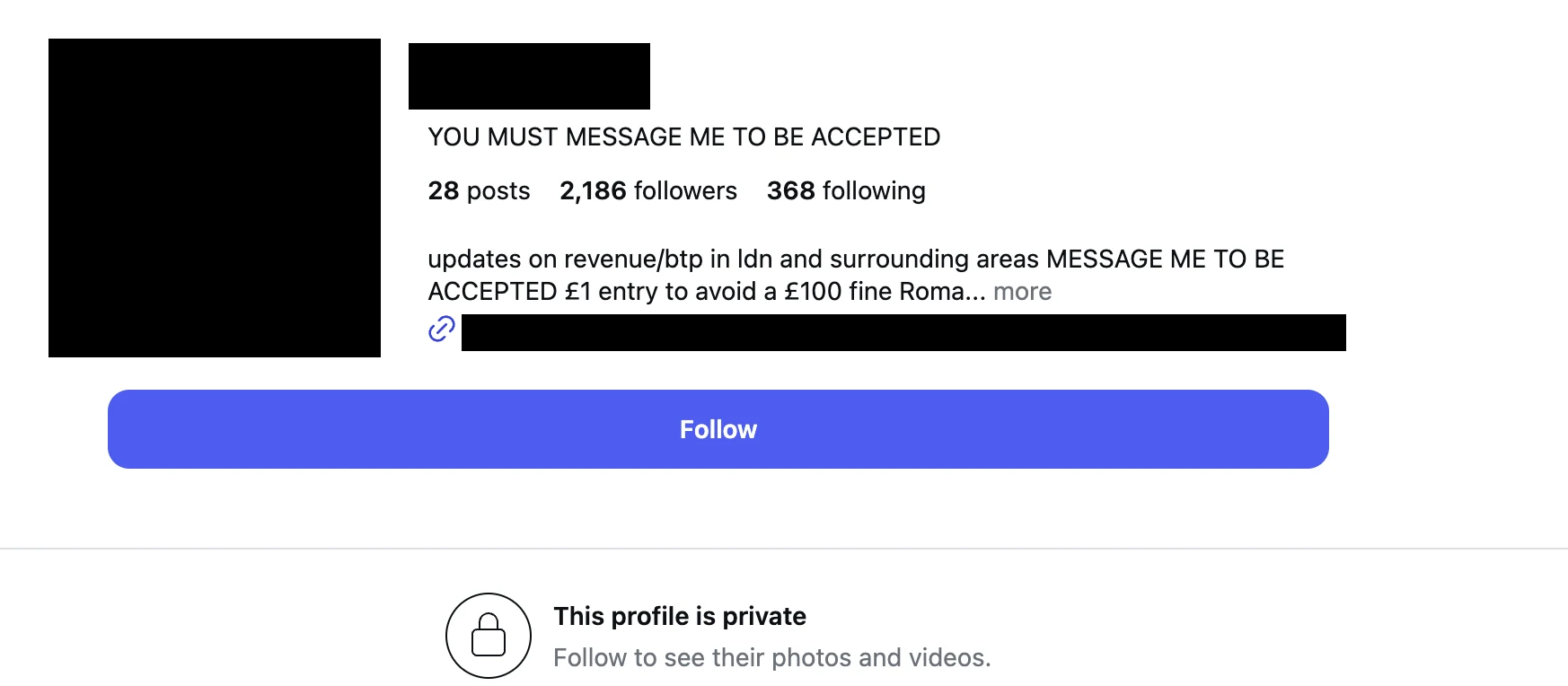
The account's public profile as it appeared on 22 August. Tube Alerter has redacted the account name, the linked map and the profile image.
Our request had been written to avoid this type of material. It explicitly excluded station-level, route-level, gateline, time-of-day, inspection-location and enforcement deployment data, and asked for the non-sensitive parts of the methodology with any sensitive sections redacted. Our request sought, among other things, the survey weighting approach, the treatment of passengers who refuse to be surveyed, the basis for the 10 per cent adjustment, and enough detail to understand how modal estimates are combined into the headline rate.
The accounts sell the locations of inspectors, but have nothing to do with how TfL's fare evasion survey is weighted.
TfL's reasoning relies on what is known as the mosaic effect: the idea that information which is harmless on its own can become harmful when combined with material already in the public domain. The review argues that continued disclosure of "detailed fare evasion and enforcement information", particularly "through news articles", could assist evaders when pieced together with other sources, and that disclosure "would be likely to increase the confidence of anyone inclined" to evade.
The mosaic effect is a recognised principle in freedom of information law. But the ICO says an authority relying on section 31 must show a real and significant risk of prejudice and a causal link between disclosure and that prejudice. TfL's response does not explain what an evader could learn from the statistical material we sought, such as a sampling design, confidence calculation or worked example, whether combined with Instagram posts or anything else.
The review did release fragments of statistical detail: a sample size, a stratification approach, the weighting stages used on rail surveys. TfL chose which fragments. We cannot establish from the outside whether they are representative, accurate or complete, because the documents they come from stay closed. Disclosure on those terms puts nothing up for scrutiny, and it undercuts the refusal. If statistical detail can be safely separated from the documents and released, the documents can be redacted, which is what our request asked for.
If the existence of accounts posting inspector locations justifies sealing the statistics, the statistics stay sealed for as long as anyone posts an inspector's location, and those accounts come and go: one of the two TfL named on 3 August was unavailable within three weeks. Other bodies take a different view. The Department for Transport publishes confidence intervals for its estimates of vehicle excise duty evasion while enforcement of that duty continues; New York's transit authority published its revised fare evasion survey methodology after an inspector general's review, and its inspectors still make checks.
What TfL says
Tube Alerter put the substance of this article to TfL. A TfL spokesperson said:
"We take fare evasion extremely seriously and are committed to tackling it. The social media accounts mentioned are examples of the wider challenges we face, as they encourage the sharing of information that could be used to undermine enforcement activity.
"While we recognise the public interest in how fare evasion estimates are produced and have disclosed information where appropriate, we also have a responsibility to protect our efforts to tackle fare evasion and safeguard fare revenue. For that reason, we carefully consider whether detailed internal documents can be released. We are committed to being as open as possible while ensuring our work to detect, deter and reduce fare evasion remains effective."
The refusal is now before the Information Commissioner's Office, which will rule on whether the exemption was correctly applied.
Sources & methodology
This article is based on Transport for London's response to a freedom of information request made by Tube Alerter (FOI-0789-2627) and on its internal review of that response (IRV-052-2526, dated 3 August 2026), which is where the quoted passages about Instagram accounts, the mosaic effect and the withheld material appear. Quotations from TfL are reproduced verbatim from the review. The original request and response are published on TfL's freedom of information site; the internal review is not, so the quotations here are from the correspondence sent to us. The description of what our request did and did not ask for is drawn from the request itself, which excluded station-level, route-level, gateline, time-of-day, inspection-location and enforcement deployment data and asked for redaction rather than refusal of any sensitive passages. The two Instagram accounts named by TfL were checked on 22 August 2026: the first returned a page stating the account was unavailable, and the second was a private account whose public profile carried the follower count and wording quoted here. We did not request access to the private account and have not seen its posts, so we cannot verify what it publishes beyond its own public description of itself. TfL named both accounts in its internal review and we have chosen not to publish those names, for the reasons set out in the article; where they appear inside a quotation from TfL they are marked as withheld. The account name, linked map address and profile image are redacted in the screenshot, we have not named the operator, and we are not linking to it. TfL was given the substance of each finding in this article and the opportunity to respond, and its statement is published in full above; it was provided by TfL's press office on 24 August 2026 and is reproduced verbatim. Comparisons with other public bodies rely on the Department for Transport's published vehicle excise duty evasion statistics and on the MTA inspector general's review of New York City Transit's fare evasion surveys and the revised methodology issued afterwards.
- TfL, FOI-0789-2627 - the original request of 9 June 2026 and TfL's response of 3 July 2026, as published on TfL's website. The disclosures discussed here are in the internal review rather than this response.
- TfL internal review IRV-052-2526, 3 August 2026 - not published by TfL; quotations are from the correspondence sent to Tube Alerter.
- Tube Alerter, TfL admits fare evasion figures include a 10% confidence cut and a bus survey passengers can decline - the earlier reporting on the estimate itself.
- Information Commissioner's Office - guidance on section 31 of the Freedom of Information Act, the law enforcement exemption, which is qualified and subject to a public interest test.
- Department for Transport, vehicle excise duty evasion statistics - roadside survey estimates published with confidence intervals.
- MTA Office of the Inspector General, fare evasion review - the review of New York City Transit's fare evasion surveys and the published redesign that followed.
We build highly customisable tube alerts for the London Underground, Overground, DLR and Elizabeth line. Choose your lines, set your time window, pick your days, and filter by severity. We will only email you when something actually affects your commute.
Set up a free alert →
TfL's £190m Fare Evasion Estimate
The figure carries a 10 per cent confidence cut TfL has never published.
Good Service, 882 Cancelled Trains
Six weeks of National Rail data against TfL's own status feed on the Mildmay line.
Every Station, Every Year
Entry and exit figures for every station on the network, 2017 to 2025.
We will update this article when the Information Commissioner's Office responds, and if TfL releases any of the withheld methodology. Send us a tip if you work on fare evasion measurement and can add context we are missing.